Published: Aug 18, 2026 by Ingrid Navarro
ControlledShifts: Towards Standardizing Robustness Evaluation in Trajectory Prediction Under Distribution Shifts
Ingrid Navarro†, Pablo Ortega-Kral†, Yutong Duan, Jonathan Francis‡ and Jean Oh‡
†Work done as part of an internship at Lavoro AI
‡Equal advising
Abstract
Trajectory prediction is central to safety in autonomous driving, yet learning-based predictors tend to degrade sharply when encountering scenarios poorly represented by their training data. Many methods attempt to mitigate distribution shift degradation through data-centric or test-time adaptation approaches; however, they are typically validated along fragmented axes of generalization, leaving the field without a standardized way to compare robustness across shifts a model may encounter.
To address this, we introduce ControlledShifts, a framework and benchmark suite that systematically re-splits existing trajectory datasets into in-distribution (SEEN) and out-of-distribution (UNSEEN) partitions, via a shared characterization-and-splitting formulation, in which a characterization function fixes the axis of variation a benchmark probes and a splitting function fixes how the tail of that axis is withheld. The suite comprises three benchmarks targeting key topological and behavioral distribution shifts. Furthermore, to aggregate multi-dimensional performance metrics across these benchmarks, we propose a unified robustness score that evaluates models along two complementary dimensions: prediction quality (relative performance gain) and prediction stability (performance preservation under shift). We showcase ControlledShifts by benchmarking prominent transformer-based architectures, exposing critical differences in how models of varying capacities handle latent relevance and environmental structure.
Motivation
At deployment time, autonomous systems inevitably face novel situations their training data covers poorly: unseen road topologies, unrelated background actor behavior, unexpected maneuvers, or erratic driving. Safety demands that a model respond sensibly to these cases, yet learning-based predictors generally degrade under such distribution shifts.
Efforts to improve robustness fall into two categories. The first targets the data, through scenario mining, as in our own SafeShift, or through coverage widening via scenario generation, as in SEAL. The second acts at test time, through uncertainty estimation, model ensembles or gradient-based shift detection.
Despite this activity, measuring how robust a model actually is remains an ad hoc exercise. Each method commits to its own axis of generalization, so robustness cannot be contextualized across methods and shift conditions. Fields such as robotics have benchmarks that aggregate distinct sources of variation; trajectory prediction in autonomous driving lacks definitive efforts towards such standardization.
Our Idea
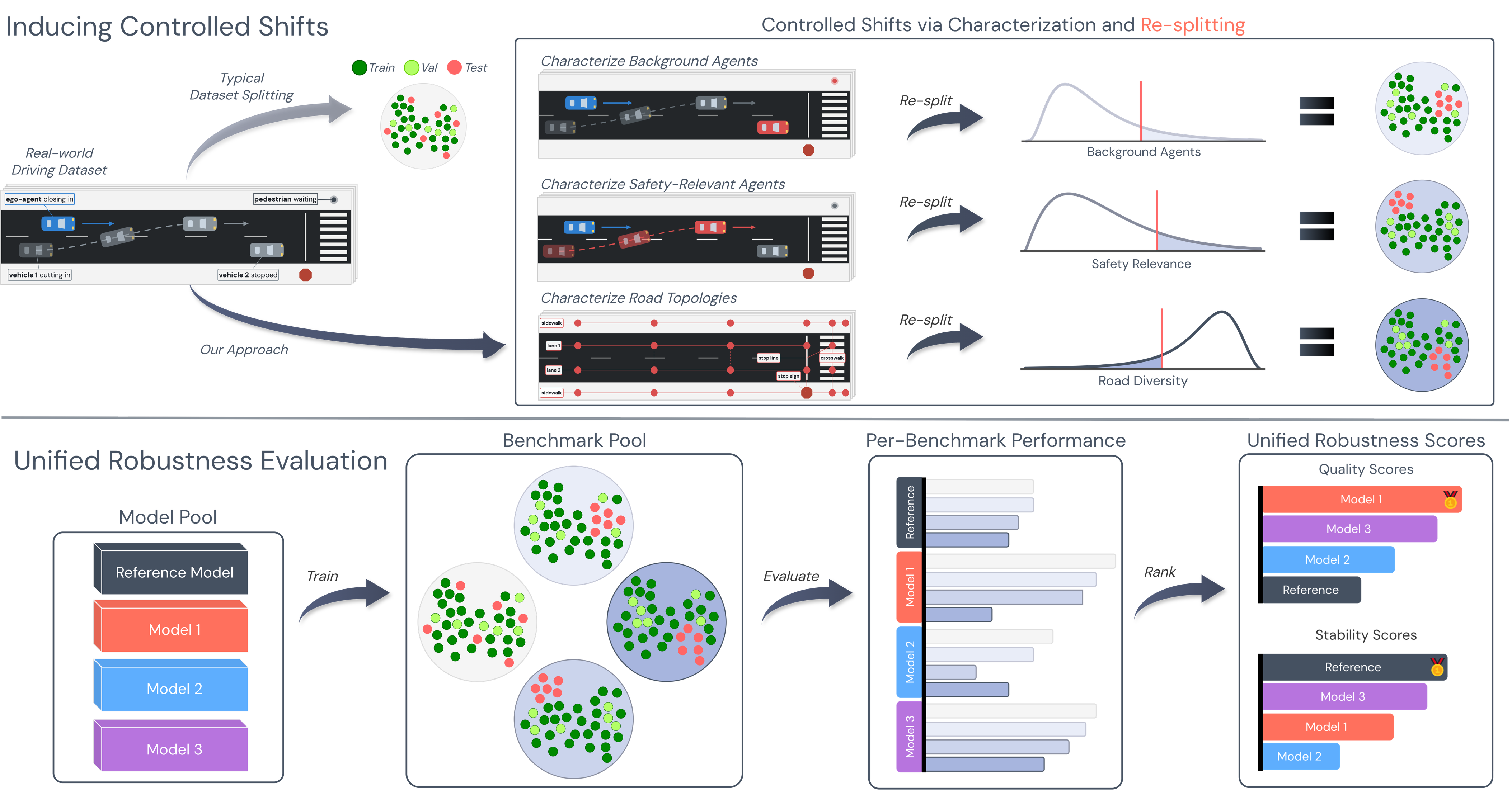
We propose ControlledShifts, a framework and benchmark suite that, rather than collecting new data, re-splits an existing dataset into SEEN and UNSEEN partitions through a shared formulation instantiated across distinct axes of variation. Our contributions are threefold.
- We formalize and unify distribution-shift creation by combining a characterization function and a splitting function into one standardized formulation for inducing controlled shifts across heterogeneous axes.
- We propose a unified robustness score condensing multi-dimensional measurements into two values per model, along the quality and stability dimensions.
- We instantiate the formulation as three complementary benchmarks targeting behavioral and topological shifts relevant to the ego-agent, and showcase our robustness scheme on key trajectory prediction models.
Inducing Controlled Shifts
To create a benchmark, we partition the scenario set into two disjoint subsets. A characterization function c
maps each scenario to a representation, and a splitting function f assigns each scenario to SEEN or UNSEEN
based on that representation, relative to the full corpus. Models are trained and validated exclusively on SEEN,
while UNSEEN is held out for testing.
Here c determines the axis of variation a benchmark probes and f how its tail is withheld, so either can be
replaced without disturbing the other. Because a benchmark is a re-splitting of existing data, scenario format and
quality are held fixed, making the induced shift the only variation; benchmarks built from different characterization
functions remain comparable, being re-splits of the same corpus scored the same way; and adding an axis requires only
a new (c, f) pair.
The Benchmark Suite
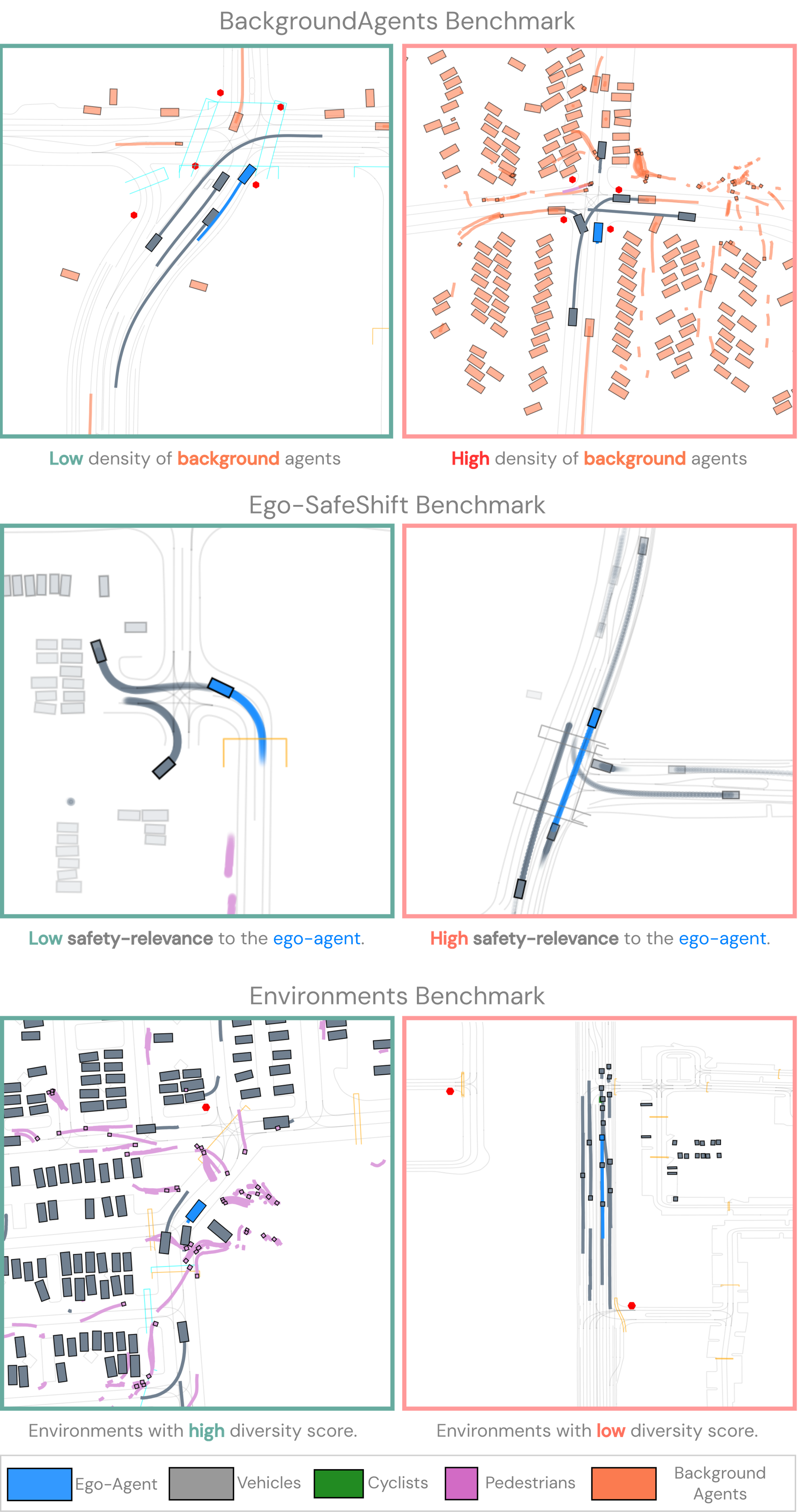
We instantiate our formulation as three benchmarks, each targeting a different aspect in which a scenario can be interesting to the ego-agent, plus a no-shift control.
| Benchmark | Characterization c |
Splitting f |
Axis probed |
|---|---|---|---|
| BackgroundAgents | Background-agent count | Top 15% held out | Distractor density |
| EgoSafeShift | Ego-centric safety score | 85th percentile | Latent criticality |
| Environments | NetLSD map-graph embedding | Highest-silhouette clusters | Map topology |
| Uniform | — | Uniform at random | None (control) |
BackgroundAgents
This benchmark builds on CausalAgents, in which human annotators labeled the agents causal to the ego-agent’s behavior, leaving the remaining ones as background agents. Masking those out should ideally leave predictions for the ego-agent unchanged. Our characterization counts them, a proxy for perturbation magnitude, and the splitting function holds out the top 15% highest-count scenarios, whose perturbed counterparts form UNSEEN, while the remainder constitutes SEEN in its original form.
EgoSafeShift
This benchmark adapts the characterization scheme of SafeShift and ScenarioCharacterization, assigning each scenario a scalar safety-relevance score and thresholding at the 85th percentile. Where the original formulation captures global safety-related properties, ours targets finer-grained characteristics that increase decision-making difficulty, so we re-score existing scenarios from the ego-agent’s perspective.
Environments
This benchmark induces a topological shift by holding out scenarios with structurally distinct maps. We convert each scenario map into a NetworkX graph and embed it with NetLSD, a heat-trace graph descriptor that is permutation invariant, scale adaptive, size invariant and scalable. Agglomerative clustering over the embeddings then assigns the highest-silhouette clusters to UNSEEN: a cleanly separated cluster is internally homogeneous and structurally distinct from the rest of the corpus, and is therefore precisely its low-diversity, topologically atypical region.
Measuring Robustness
Given an induced shift, the goal is to minimize performance degradation from SEEN to UNSEEN. Degradation on its own, however, is insufficient: a weak predictor can degrade little simply because it had little to lose. We therefore measure robustness along two dimensions, each fixed by the reference a predictor is compared against.
- Quality captures downstream performance, measuring a model against a Naive baseline given neither map nor social context.
- Stability captures how well a model maintains its performance under shift, measuring it against its own counterpart trained on the Uniform setting, where no controlled shift is applied.
The score is built in three steps. For a given metric, the split ratio divides the reference’s score by the predictor’s on that split; every metric is an error measure, so a ratio above 1 means the predictor beats the reference. The per-benchmark score combines the SEEN and UNSEEN ratios via a geometric mean, which penalizes imbalance between the two, and averages across metrics. The unified robustness score then averages those over the three shifted benchmarks, giving one value per predictor and dimension.
Results
We validate on the Waymo Open Motion Dataset (WOMD), using a subset of ~45K scenarios re-split 70% / 15% / 15% under each benchmark. Every model is trained once per benchmark, so all differences are attributable to the induced shift. We evaluate four transformer-based baselines spanning diverse capacities, AutoBot (1.5M parameters), SceneTransformer (7.6M), Wayformer (15.1M) and MTR (27.2M), against the Naive reference (624k), on the standard MinADE6, MinFDE6, BrierFDE, MissRate and CollisionRate metrics.
Under the Uniform condition, models lose less than 1% on average, while the proposed shifts degrade them substantially, and each in a distinct way.
- BackgroundAgents produces substantial behavioral degradation, with MinADE6 rising 23.8% on average, yet a marked drop in collision rate (−21.9%), since predictions rarely collide with non-background agents.
- Environments shows the same signature, +12.7% MinADE6 against −5.4% collision rate. The held-out topologies demand less interaction understanding and maneuvering, but still require sound longitudinal operation.
- EgoSafeShift shows the smallest gap in the FDE-based metrics (+10.9%) but the largest increase in collision rate (+25.6%). The UNSEEN set surfaces latent criticality, demanding a model’s grasp of safety relevance.
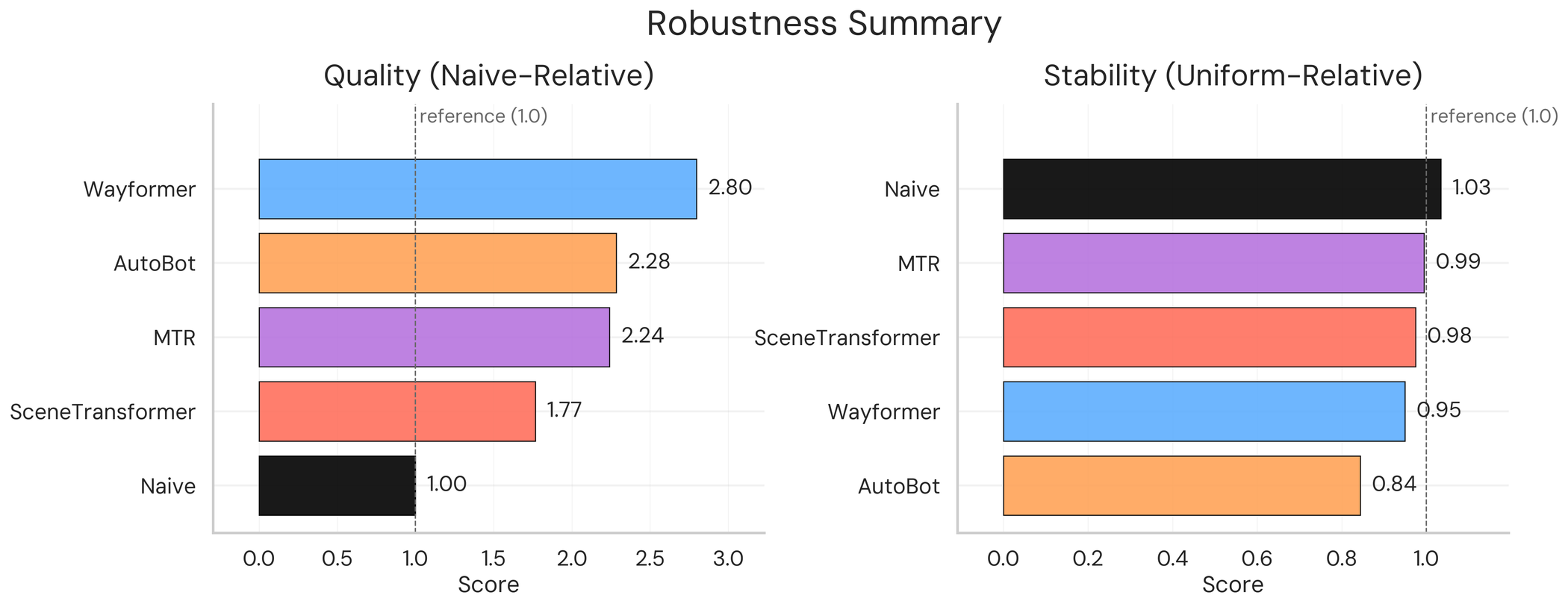
The two rankings turn out to be close to inverses of one another. This is not by construction, as a predictor could lead on both dimensions, so it validates that changing the reference captures complementary aspects of robustness rather than a single underlying ordering.
On quality, Wayformer ranks highest, outperforming on displacement error metrics across benchmarks. However, like SceneTransformer and MTR, it falls below the Naive reference on collision rate, suggesting that the accuracy gains of high-capacity models are largely confined to the geometry of the modal trajectory and do not translate into proportionate improvements in safety-aligned metrics. On stability, every learned model degrades more than Naive, and the pattern inverts: the higher-capacity models lose displacement error stability while improving on collision rate, whereas AutoBot degrades on every metric and scores lowest, despite being the strongest model on collision rate throughout. Relative degradation alone is therefore a misleading proxy for downstream reliability.
Check out our paper and the benchmark suite for more details!
BibTeX
@article{navarro2026controlledshifts,
  title={ControlledShifts: Towards Standardizing Robustness Evaluation in Trajectory Prediction Under Distribution Shifts},
  author={Navarro, Ingrid and Ortega-Kral, Pablo and Duan, Yutong and Francis, Jonathan and Oh, Jean},
  journal={arXiv preprint arXiv:2608.17882},
  year={2026}
}